About
The Emailnotifications module lets you set up and customize automated email notifications triggered by specific user actions.
You can notify channel moderators when new items are awaiting moderation, inform media creators when their content is approved or rejected, and much more.
The Event Notifications feature must be enabled at the account level for email notifications and channel subscriptions to work. If it isn't enabled, contact your Kaltura representative.
Changes to Application specific notifications apply only to the current application. Notifications of type Reach and External apply across all Content Hub, legacy Video Portal and KAF instances under the same Kaltura Partner ID.
Configure the module
- Go to your Configuration Management console, and click the Emailnotifications module. You can also navigate directly using a link: https://{your_site_url}/admin/config/tab/emailnotifications.
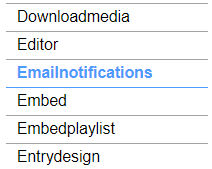
- Enable the module by selecting 'Yes'.
- Click Save to apply your changes.
- Click Manage notifications.
The 'Emailnotifications' page opens.


The 'Email Notifications' page displays.

Notification types
Email notifications are grouped by type:
- Application specific – Changes apply only to the current application.
- Reach and External – Changes apply across all Content Hubs, legacy Video Portal and LMS instances under the same Kaltura Partner ID.
If both Application specific and External versions of the same notification are enabled, users may receive duplicate emails.
REACH notifications will appear in the list only when the REACH module is enabled and configured.
Sender details
The default sender details are:
- Name: Kaltura Automated Response
- Email: customer_service@kaltura.com
You can customize these fields per notification. Each field supports one value.
Configure notifications
You can enable notification events and customize their email templates.
Each notification includes:
- Recipient
- Type
- Subject
- Body
- Sender name and email
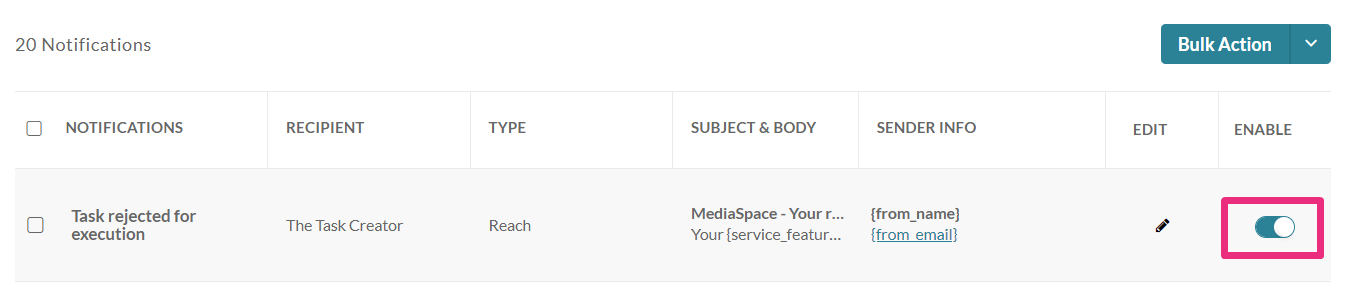
- Use the toggle to enable or disable a notification.
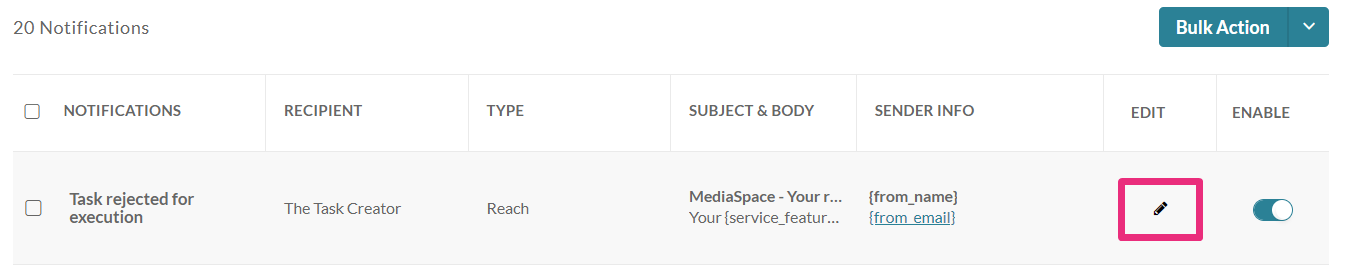
- Click the pencil icon to edit the notification.
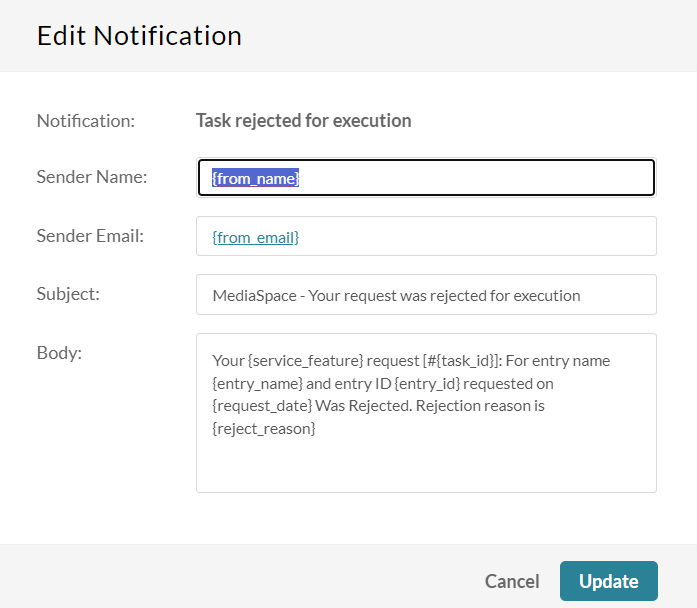
- Make the desired changes to the sender name, sender email, subject and / or body text.
- Click Update.
- Customer step: Approve Kaltura to send on behalf of your domain by adding an SPF record. Use the value provided by Kaltura (for example: include:_spf.kaltura.com).
- Kaltura step: Kaltura will then whitelist the email in your admin console and update the notification templates.
- To update multiple notifications, select them and use the bulk actions menu to enable, disable, or edit sender information, then click Update.
All notifications are disabled by default.
Changing the sender email requires steps by both the customer and Kaltura:
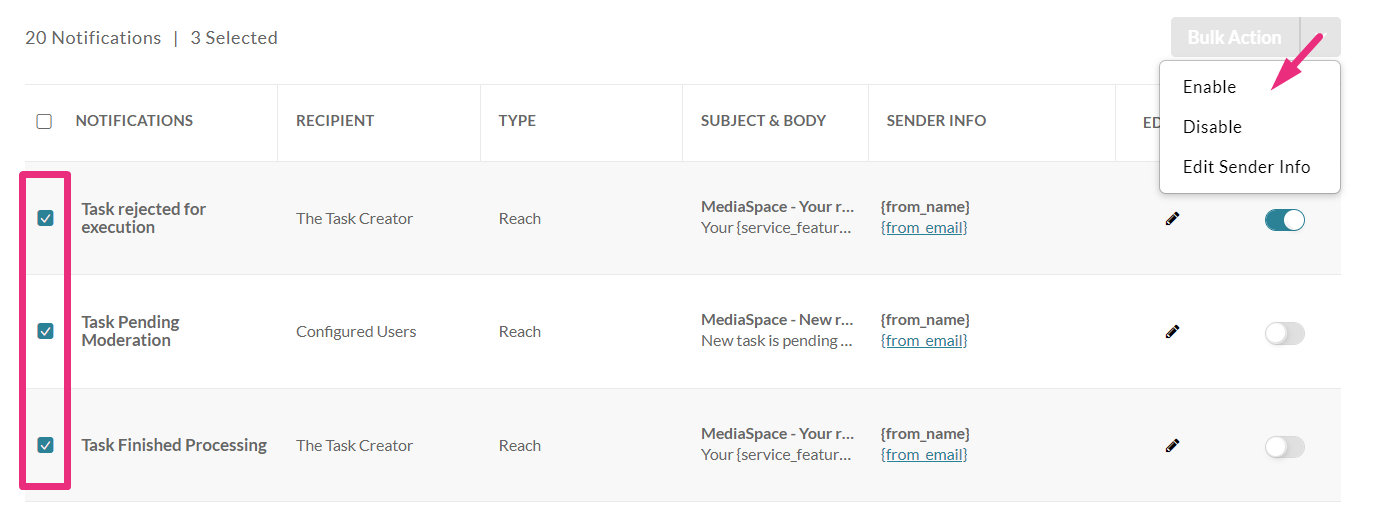
Notification events
The Email Notifications page lists all available notifications triggered by system actions.
Reach notifications
| Event | Recipient | Type |
|---|---|---|
| Task rejected for execution | Task creator | Reach |
| Task pending moderation | Configured users | Reach |
| Task finished processing | Task creator | Reach |
| Task approved for execution | Task creator | Reach |
Application specific notifications
| Event | Recipient | Type |
|---|---|---|
| New item pending moderation | Category moderators | Application specific |
| Entry approved in category | Entry creator | Application specific |
| Entry rejected in category | Entry creator | Application specific |
| Entry approved | Entry creator | Application specific |
| Entry rejected | Entry creator | Application specific |
| Entry ready | Entry creator, account owner | Application specific |
| User added to category | Category member | Application specific |
| User role changed in category | Category member | Application specific |
| User removed from category | Category member | Application specific |
| Entry added to channel | Channel subscribers | Application specific |
| Comment added to entry | Entry creator | Application specific |
| Reply to comment | Original comment creator | Application specific |
| Comment deleted | Comment creator | Application specific |
External notifications
| Event | Recipient | Type |
|---|---|---|
| Entry rejected | Entry creator | External |
| Entry approved | Entry creator | External |
| Entry ready | Entry creator, account owner | External |
Content parameters
You can use dynamic parameters in email templates. The following parameters are available:
The term 'category' in this guide refers to both a 'gallery' and 'channel' in Content Hubs, legacy Video Portal, and to the Media Gallery in LMS applications.
- from_email - sender email
- from_name - sender name
- from_email - Server configuration: partner_notification_email
- from_name - Server configuration: partner_notification_name
- entry_id - entry ID
- entry_name - entry name
- comment_text - comment text
- comment_id - comment ID
- category_id - category ID (entry context)
- delete_user_id - ID of the user who deleted the comment
- creator_id - entry creator user ID
- creator_name - entry creator name
- creator_email - entry creator email
- category_name_encoded - HTML-encoded category name (better to use in the message body)
- reply_user_id - ID of the user who wrote the reply
- role - user role
- remover_user_id - ID of the user who executed this action
- request_date - date requested
- AppTasksUrl
- service_feature
- #{task_id}
- reject_reason - reason for rejection