About
The Custom Embed Code module enables Content Hubs/legacy Video Portal users to generate custom embed codes containing dynamic entry metadata such as title and description.
The HTML template can have special placeholders that will be replaced with certain content:
- {wid} - will be replaced with widget id.
- {entryId} - will be replaced with entry id.
- {hostName} - will be replaced with host name.
- {uiConfId} - will be replaced with uiConfId (player id).
- {overrideCssUrl} - will be replaced with contents of overrideCssUrl field.
- {playButtonImageUrl} - will be replaced with contents of playButtonImageUrl field.
- {isSecureEmbed} - will be replaced with true or false depending on what was selected during iframe code generation.
Once enabled, a new tab will be available on the Entry page. Here users can configure the embed's access level and easily copy and share the embed link as needed.
This guide explains how to enable and configure the Custom Embed Code module in the Configuration Management console.
This module is available for both Content Hubs and legacy Video Portal.
For technical support, contact Kaltura Customer Care. For all other inquiries, reach out to your Customer Success Manager.
Configure
- Log into the Configuration Management console by going to your Content Hubs/legacy Video Portal URL and adding /admin at the end.
- Enter your Kaltura user ID and password.
- Click Sign In.
The Configuration Management console displays.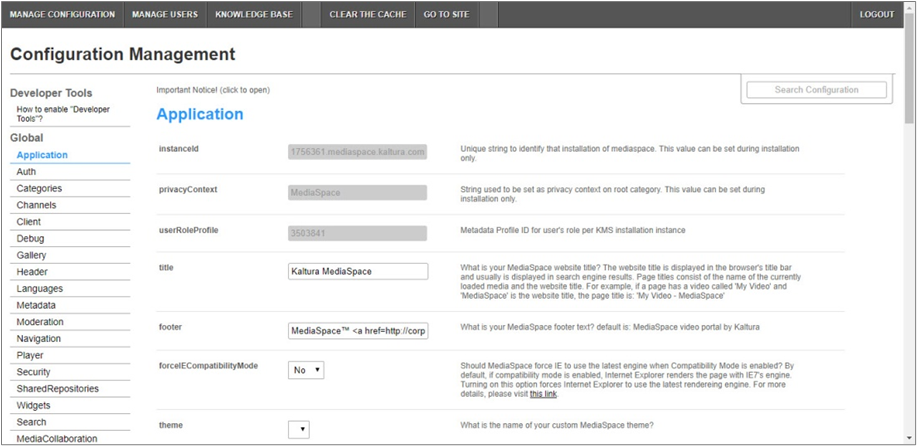
- In the list of configurable items on the left of your screen, locate and click on Customembedcode. (The item will be crossed out because it's disabled by default.)
- The Customembedcode window displays.
The Module Info box displays the module name, description (what enabling this module allows users to do), and version number.
- In the enabled pull-down list, select Yes to enable the Customembedcode module.
Other configurable items following the enabled pull-down list are as follows. - Click Save.
If this module is not in your Content Hubs/legacy Video Portal application, please get in touch with your Kaltura representative to inquire about adding it.

| Configuration Name | Options | Description |
| uiConfID | Text box | Embed code will be generated with the configured uiConf, In case this field is empty the default “playerId“ configured under Player module will be considered |
| tabTitle | Text box | KMS admin will be able to define the share tab name |
| embedAllowed | Owner Only, Co-Editor, Co-Publisher, Specific users/Groups, anonymousRole, viewerRole, privateOnlyRole, adminRole, unmoderatedAdminRole, unconfirmedViewer Role | Define which role will be allowed to generate embed codes. |
| overrideCSSURL | Text box | URL to an alternate CSS, to allow a customer to customize the iFrame design to fit corporate style guide. |
| playButtonImageURL | Text box | URL to an alternate CSS, to allow a customer to customize the player button to fit corporate style guide. |
| htmlTemplate | Text box | Kaltura will generate by default a pre-defined embed structure where KMS will be able to modify the entry generated embed code |
You receive a notice that your configuration for Customembedcode was saved and the cache was cleared.
End user experience
Content Hubs:
The example below shows the new tab (named "Custom Embed Code" by the administrator) available on the Actions menu on the Entry page.


Legacy Video Portal:
The example below shows the new tab (named "My Embed" by the administrator) available on the "Share" tab on the Entry page. Users can now configure the embed's access level and easily copy and share the embed link as needed.

This document is maintained by Kaltura’s Professional Services team. Please send comments or corrections to your Customer Success Manager. Ask them to forward it to the Professional Services team. We are committed to improving our documentation and your feedback is appreciated.